MOBILE BILLBOARD ADVERTISING
A mobile billboard is exactly what it sounds like — your creative mounted on a truck that drives directly to your audience.
Brands buy this format because it eliminates the single biggest weakness of static outdoor: waiting for the right eyes to pass by. With a mobile billboard truck, your brand moves. Your audience doesn't have to.
-
GPS-verified reporting
-
Permits handled for you
-
Route plan in 24 hours

Your Brand Goes Where the Audience Is
12+
Neighborhoods Per Day
A single mobile billboard truck can hit over a dozen target zones, venues, or competitor storefronts in one day.
3
Ad Faces Per Truck
Premium configurations deliver left side, right side, and rear-facing panels — three simultaneous ad faces in slow-moving traffic.
GPS
Verified Every Route
GPS tracking logs, timestamped photography, and route reports — proof of placement that static OOH can never deliver.
What Is Mobile Billboard Advertising?
A mobile billboard is a wheeled advertising display — typically a flat-panel truck, LED screen vehicle, or wrapped trailer — that follows a planned route through high-traffic areas.

Unlike a fixed sign anchored to one intersection, a mobile ad truck can hit a dozen neighborhoods, venues, or competitor storefronts in a single day. What unites every format: the brand moves. The audience doesn't have to.
Mobile billboard advertising is the only OOH format where you dictate exactly where and when your creative appears — not the landlord, not the algorithm, not the location of a fixed structure. You choose the route, the timing, and the target.
Mobile Billboard Format Spectrum
-
Wrapped trucks— vinyl graphics covering the full body of the vehicle
-
Backlit panel trucks— illuminated static boards mounted to the truck bed
-
LED trucks— full-motion video screens capable of running multiple creatives
-
Scrolling trucks— rotating panels that display several ads in sequence
-
Trailer boards— large-format static or lit panels towed behind a cab
Recent Mobile Billboard Advertising Campaign
From a single landmark location to a network of thousands, our inventory is built to support your brand's ambition.


MOBILE BILLBOARD FORMATS & SPECS
Pick the Right Truck for Your Campaign.
Choosing the right format depends on your creative, budget, and campaign goal. Here's how the main options break down — and what each one is actually built for.
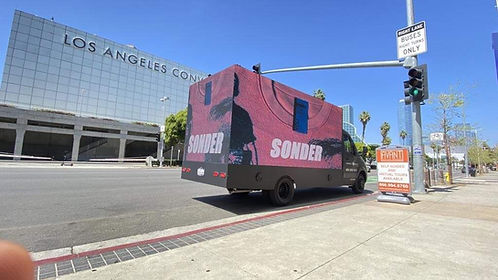
🚛 Wrapped Vinyl Trucks
Vinyl graphics covering the full body of the vehicle. Best for brand awareness and high-contrast imagery over longer campaigns. Limitation: static creative — changes require a new print.
Display area: typically 10 ft × 22 ft per side + rear panel
$600 – $1,200/day · $3,000 – $6,500/week

💡 Backlit Panel Trucks
Illuminated static boards, single or double-sided. The backlight dramatically boosts drive-by impressions after dark — essential for nighttime events, retail promotions, and bar/restaurant district campaigns.
Display area: 10 ft × 20 ft illuminated panels
$800 – $1,500/day · $4,000 – $8,000/week

📺 LED Trucks (Video Trucks)
Full-motion video screens. Swap creative in real time, run multiple brands on one truck in sequence. The premier format for product launches, tradeshows, conventions, political campaigns, and sports events. If you're weighing LED truck formats against fixed-location screens, see our LED billboard guide →
Display area: 8 ft × 14 ft to 10 ft × 20 ft · 6mm–10mm pixel pitch
$1,200 – $3,500/day · $6,000 – $18,000/week

🔄 Scrolling Trucks
Three to five rotating panels per side. Best for multi-product advertisers or agencies running several clients on one buy. Design for instant recognition — dwell time per creative is shorter than on LED or vinyl.
Display area: 3–5 rotating panels per side
$900 – $2,000/day · $4,500 – $10,000/week
Double-sided vs. single-sided: Most mobile billboard trucks are double-sided by default. A few premium configurations add a rear-facing panel, giving you three simultaneous ad faces — useful in slow-moving traffic or parade-style routes.
MOBILE BILLBOARD ADVERTISING COST
Pricing varies by market, format, and campaign length. Here are real working ranges — and the factors that move the number up or down.
Quick Answer — 2026 Mobile Billboard Pricing
Mobile billboard truck advertising starts at $600/day for a wrapped vinyl truck in a mid-size market and runs to $3,500/day for an LED truck in a top-tier metro. Weekly rates range from $3,000 to $18,000 depending on format and city. Permits add $50–$300/day in most markets.
Because we're a boutique agency, we're not tied to specific inventory, which allows us to find you the most competitive rates in the industry. We will build a custom media plan for your brand, ensuring you get maximum impact without overspending
FORMAT | DAILY RATE (EST) | WEEKLY RATE (EST) |
|---|---|---|
Scrolling truck | $900 – $2,000 | $4,500 – $10,000 |
LED / video truck | $1,200 – $3,500 | $6,000 – $18,000 |
Backlit panel truck | $800 – $1,500 | $4,000 – $8,000 |
Wrapped vinyl truck | $600 – $1,200 | $3,000 – $6,500 |
WHAT DRIVES COST UP
-
Major metro markets (NYC, LA, Chicago, Miami) carry a 20–40% premium over mid-size cities
-
Event-adjacent routes (near a tradeshow or stadium on game day) command surge pricing
-
Permits — some cities require per-day permits ranging from $50 to $300+
-
Driver
WHAT DRIVES COST DOWN
-
Multi-week or multi-month commitments
-
Off-peak scheduling (weekday daytime in non-event periods)
-
Bundling multiple trucks under one buy
-
Combining with static OOH in a single campaign package
For a full picture of how mobile billboard ads compare to fixed formats on a cost-per-thousand basis, see our guide on how much a billboard costs →
Mobile Billboard Trucks Win When Static Can't.
🎯
You Need to Own a Specific Moment
Event marketing is where mobile billboard advertising dominates. Parking a fleet of LED trucks outside a conference center during a major tradeshow or convention puts your brand in front of a highly targeted, pre-qualified audience — people already in buying mode.
Best format: LED truck · 1–3 day burst
⚔️
You Want Competitor Conquesting
Route a mobile ad truck past a competitor's flagship store, their trade show booth's exit, or their office park. It's aggressive, legal in most markets, and highly effective for challenger brands looking to intercept a competitor's audience at the point of highest intent.
Best format: Vinyl or LED · Sustained routing
📊
You Need Proof of Placement
Unlike a static board, a mobile billboard campaign can be documented with GPS logs, timestamped photos, and route reports. Clients who need campaign verification — agencies, political advertisers, and compliance-sensitive brands — choose mobile precisely because every impression is provable.
All formats: GPS-verified route reporting included
📍
Your Audience Is Concentrated but Moving
Festival crowds, stadium exits, political rallies, Pride parades, product launch pop-ups. The truck goes where the density is, then repositions. No static billboard can follow an audience from venue to venue.
Best format: LED or backlit truck · Event-day routing
📱
You're Running Geofencing in Parallel
Pair truck billboard advertising with a geofencing campaign. As the truck drives through a zone, serve mobile ads to devices in that same area. According to the OAAA, OOH advertising drives more online activity per dollar spent than any other traditional medium. The one-two punch compounds recall significantly.
Best combo: LED truck + mobile geofencing
🏢
Combine With Large-Format Static
For campaigns that need both mobile flexibility and large-format static presence, wallscape advertising in major metros creates a powerful surround-sound effect — the wallscape anchors a location, the truck extends your reach into target zones that fixed inventory can't cover.
Best strategy: wallscape anchor + mobile amplification
How WE Build Mobile Billboard Campaign
We Don't Hand You a Truck and a Map.
We build the campaign around your objective — not around available inventory. Here's exactly what happens from brief to wheels rolling.
1
Audience & Objective Mapping
Where does your target audience concentrate? When? We cross-reference event calendars, foot traffic data, and competitive intel before a single route is drawn.
2
Format Selection
Vinyl wrap for sustained brand awareness. LED truck for launch moments. Scrolling truck for multi-creative campaigns. We match format to goal — not to inventory.
3
Route Design & Permitting
Our team handles city permits, driver coordination, and route optimization. We build in contingency routes for traffic or event-day closures. For detailed route strategy, see our guide on planning effective mobile billboard routes →
4
Creative Guidance
Mobile billboard ads live or die by creative. High contrast. Minimal copy. Bold logo placement. Five words or fewer is the industry benchmark. We review every asset before it goes on a truck.
5
Reporting & Verification
GPS tracking, route logs, timestamped photography, and impression estimates sourced from Geopath-calibrated traffic data. You know exactly where your truck was and when.
6
Integration With Broader OOH
Mobile rarely runs alone. We layer it with digital billboard placements, geofencing, and — when the market calls for it — static formats to create full-market saturation.
Ready to put your brand in motion?
Mobile Billboard Advertising FAQs
How much does a mobile billboard truck cost per day in a major city?
In top-tier markets like New York City or Los Angeles, expect to pay $1,200–$3,500 per day for an LED truck and $600–$1,200 for a wrapped vinyl truck. Rates include the driver but typically exclude permits, which can add $50–$300 per day. Multi-day bookings almost always unlock lower daily rates.
Are mobile billboards legal in all US cities?
Most major US cities permit mobile billboard trucks, but regulations vary. Some cities restrict idling or parking a truck in one location for extended periods. Others require specific permits per route or per day. Our team handles permitting research and compliance as part of every campaign plan.
What is a mobile billboard truck and how does it differ from a standard billboard truck?
A mobile billboard truck is a vehicle fitted with a large advertising display that drives a planned route. A standard billboard truck refers to the vehicle used to service or install static signs. The key difference: a mobile billboard truck is the ad unit itself, actively moving your creative through target areas rather than simply transporting materials.
What is the difference between a mobile billboard and a digital billboard?
A mobile billboard is a vehicle-mounted display that travels a planned route; a digital billboard is a fixed LED screen at a permanent location. Mobile formats offer geographic flexibility and event targeting, while fixed digital boards deliver consistent, high-frequency impressions to commuters passing the same location repeatedly. Many campaigns use both.
How long should a mobile billboard campaign run?
For event-driven campaigns (tradeshow, product launch, festival), one to three days of concentrated truck activity can generate strong results. For brand-awareness campaigns, two to four weeks of consistent routing builds the frequency needed to drive recall. Six to twelve weeks is common for political advertisers and challenger brands running sustained competitor conquesting.
What are the advantages of truck billboard advertising over static formats?
Truck billboard advertising lets you bring your message directly to a specific audience at a specific time — something a fixed sign can't do. You can reposition mid-campaign, target event crowds, conquer competitor locations, and document every impression with GPS data. For time-sensitive launches or event-driven campaigns, the flexibility of a billboard truck is hard to match with any static format.
Can mobile billboard advertising be targeted using geofencing?
Yes — and it's one of the most effective combinations in modern OOH. As the truck drives through a defined area, a geofencing campaign can simultaneously serve mobile ads to smartphones in that same zone. This pairing increases ad recall significantly compared to either tactic alone, according to research cited by the OAAA.
What creative specs do I need for a mobile billboard truck?
Standard vinyl wrap panels run approximately 10 ft × 22 ft per side. LED trucks accept video files at resolutions matched to their pixel pitch (commonly 6mm–10mm). For all formats: high contrast, minimal text (five words or fewer is the industry benchmark), and a single clear call to action. We review all assets before production.
What is a mobile billboard truck called in the industry?
Industry terms include mobile billboard, mobile ad truck, LED truck, video truck, billboard truck, and truck billboard advertising. "Mobile billboard" is the most common consumer search term; "LED truck" is the most common term when buyers specifically want full-motion video capability.
Top Markets for Mobile Billboard Advertising
Mobile billboard ads work in virtually every US market, but these metros deliver the highest volume of drive-by impressions and the most route flexibility.

Own the media capital of the world. We put your brand in front of millions of city residents and global tourists.


